How build & deployment shapes software architecture – WebPerfDays 2012

It was a privilege to be part of the first WebPerfDays EU in London on 5th October 2012. Together with the folks from CCPGames, I facilitated a session on Continuous Delivery, opening the discussion with an overview of how build & deployment shapes software architecture at thetrainline.com:

Slides: How build and deployment shapes software architecture at thetrainline.com

The Continuous Delivery session prompted some excellent discussions around CD; there seems to be interest in setting up a London-based meetup, which I agreed to help coordinate.

Kudos to Steve Thair (@TheOpsMgr) and team for organizing such an excellent event.


Event-Sourced Architectures by Martin Thompson at QConLondon 2012

Software performance guru Martin Thompson (@mjpt777) gave an illuminating talk on event-sourced architectures, and why event-driven, state-machine designs are the way forward for complex, multi-path software systems (Event Sourced Architectures and what we have forgotten about High-Availability”, [slides: 700KB PDF]).

QConLondon 2012 blog posts
See all QConLondon 2012 blog posts…

Continue reading Event-Sourced Architectures by Martin Thompson at QConLondon 2012

Fault tolerance, anomaly detection, and anticipation patterns by Jon Allspaw at QConLondon 2012

Jon Allspaw (@allspaw) from Etsy talked about the role that Anomaly Detection, Fault Tolerance and Anticipation play in producing highly scalable software systems (Fault tolerance, anomaly detection, and anticipation patterns, slides [PDF, 5MB]).

As head of technical operations at Etsy, whose web traffic is pretty substantial, Jon focused on resilience in software systems: what it is, and how to achieve it.

QConLondon 2012 blog posts
See all QConLondon 2012 blog posts…

Continue reading Fault tolerance, anomaly detection, and anticipation patterns by Jon Allspaw at QConLondon 2012

Breaking the Monolith by Stefan Tilkov at QConLondon 2012

Stefan Tilkov (@stilkov) from innoQ gave an excellent talk on the importance of a “system-of-systems approach” to software architecture (Breaking the Monolith, slides [PDF, 1MB]). [Update: the video is now online here: http://www.infoq.com/presentations/Breaking-the-Monolith]

In essence, he argued for a distinction between micro-architecture (the design of the individual [sub]system) and macro architecture (the design of interacting systems).

QConLondon 2012 blog posts
See all QConLondon 2012 blog posts…

Continue reading Breaking the Monolith by Stefan Tilkov at QConLondon 2012

Talk: a Sitecore-based multilingual website (Arabic and English) for Virgin Mobile & Qtel – Dreamcore EU 2011

I presented at the Sitecore partner & developer conference DreamcoreEU in 2011; I spoke about implementing a Sitecore-based multilingual website (Arabic and English) for Virgin Mobile & Qtel [PDF].

DreamcoreEU 2011 logo

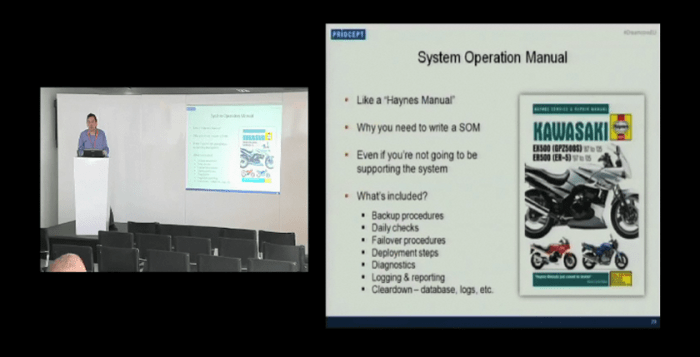
I gave a particular emphasis to multilingual concerns and planning for effective web operations:
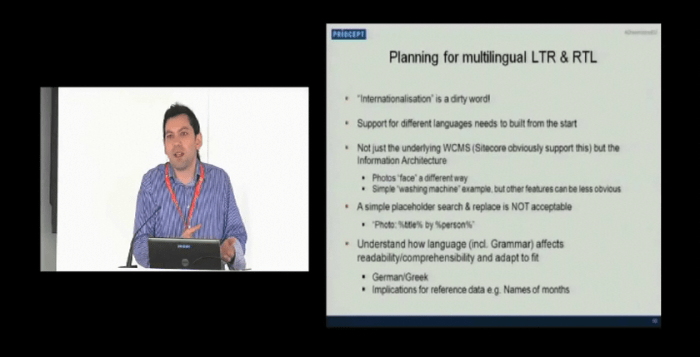
DreamcoreEU-2012_Multilingual

DreamcoreEU-2012_Operations-4

DreamcoreEU-2011_SOM

(Terrible moiré effect due to stripy shirt – I now have a plain one 🙂 )

To quote from the DreamcoreEU 2011 site:

Going global is much more than just making a site multilingual. If your web properties span the globe, you need to know the best techniques for architecting your Sitecore solution to support a global presence. This session will feature an inside-look at how Virgin Mobile took their brand into to the Middle East. ). The session will cover:

  • Why Sitecore is a first-class WCMS for multi-lingual, left-to-right and right-to-left websites
  • Planning for and implementing right-to-left (RTL) languages in your Sitecore website
  • Using Sitecore’s content modeling to implement product information management (PIM) features
  • Getting your Sitecore content strategy right
  • Developing, deploying and testing multi-server Sitecore installations effectively

In particular, I spoke about how internet technology consultants Priocept had led the effort to roll out the entire system within six months and the challenges we overcame in order to do that, emphasising the need to deploy to Production as early as possible and test with real data, networks and configurations.