Blog

Who Owns My Operability?

Includes recommended reading for software operability: SoftwareOperability.com

Matthew Skelton (@matthewskelton)'s avatarSoftware Operability

Operability is not something which can be ‘bolted on’ or retrofitted to software after it goes live; we need to design and build our software with operability as a first-class concern. You don’t build a bridge, then try to add load-bearing capabilities at the end of the project — but most software projects try to do exactly that, typically with costly results.

Ultimately, the product owner should be responsible for ensuring that operational requirements are prioritized alongside end-user features. If you are responsible for the software product or service, there is only one answer to the question

Who Owns My Operability?
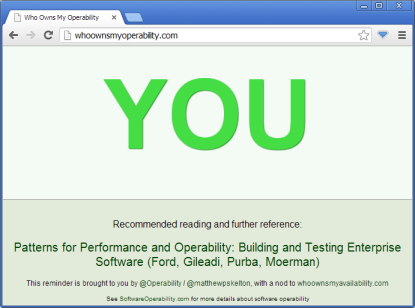
Who Owns My Operability?

Update: the site now shows selected recommended reading on each page load.

(With a nod to whoownsmyavailability.com)

View original post

Tutorial – How to build your own website using HTML and WordPress

I have published a set of workshop notes on Github called Build Your Own Website – A Beginner’s Guide, covering the basics of HTML and WordPress-driven websites. I gave the workshop at a recent Engineering Day event at thetrainline.com, where the audience was largely non-engineers from marketing/finance/HR etc., and it was interesting and useful to return to the first principles of HTML in ways accessible to novices.

Continue reading Tutorial – How to build your own website using HTML and WordPress

Cloud Deployments – Alex Papadimoulis at QConLondon 2013

Alex Papadimoulis (@apapadimoulis) of Inedo (and TheDailyWTF) gave a really useful talk on deployments for cloud-based software systems at QConLondon 2013 recently [slides, PDF, 1.6MB].

He stressed the importance of finding the appropriate deployment (distribution + delivery) model for each application, and to keep deployments as simple as possible. In fact, we can follow the best practices from Continuous Integration and apply them to deployment.

Continue reading Cloud Deployments – Alex Papadimoulis at QConLondon 2013

Comic Relief, @garethr, @LordCope, and CloudFoundry at QConLondon 2013

I attended QConLondon 2013 last week; what I took from the first four sessions in the Building for Clouds track was: cloud API and infrastructure automation tools have now solved most of the ‘easy’ cloud problems, but harder challenges (such as automating clusters) remain. The sessions were from Tim Savage (@timjsavage) and Zenon Hannick (@zenonhannick) on Comic Relief’s unique challenges with performance testing, Gareth Rushgrove (@garethr) on how to avoid PaaS lock-in, Stephen Nelson-Smith (@LordCope) on how to use Chef to give you ‘optionality’ with different cloud vendors, and Andrew Crump (@acrmp) and Chris Hedley (@ChristHedley) on the CloudFoundry cloud platform.

Continue reading Comic Relief, @garethr, @LordCope, and CloudFoundry at QConLondon 2013

What Makes an Effective Build and Deployment Radiator Screen?

Build screens (or build monitors, or information radiators) are an important tool in helping to achieve Continuous Integration and in trapping errors early. When the number of build jobs becomes large, it can be tempting to hide ‘successful’ jobs to save space, but we found this to cause problems. I realised that people need to know the context for the red jobs if they are to take prompt action to fix failing builds, so it’s important to represent the full state of all builds by showing green jobs too.

Continue reading What Makes an Effective Build and Deployment Radiator Screen?